
The Official Languages Found in the Most Countries Around the World
Last update: 11/24/2026
Official Languages Around the World: The 2026 Edition
Our 2021 chart below counted a language wherever a country used it officially, in law or in practice. For this 2026 edition we recounted every country with a stricter rule: a language counts only where a constitution or national law (in the US, an executive order) makes it official at national level. We checked 197 countries: the 193 UN members, the Holy See, Palestine, Kosovo and Taiwan. Our 2021 edition follows below.
French Is Official in the Most Countries
On that rule, French is official in 23 countries, English in 20, Arabic in 20 and Spanish in 16, followed by Portuguese and German (6 each). English is a language of government in far more places: in 35 more countries, such as Nigeria, Ghana and Jamaica, it is used officially in practice, or named only for parliament or the courts, without a law making it official. Counting those, English would lead with 55.
In 58 of the 197 countries we found no constitution or national law that makes any language official, among them the United Kingdom, Australia, Japan and Mexico. Some name a national language without calling it official (Mexico, Vietnam), some fix only the language of parliament, and others have no language clause at all.

Figure 1. French is official in 23 countries, more than any other language, counting only designations we confirmed in a constitution or national law. Source: Word Tips recount of constitutions and national laws for 197 countries, checked 23 November 2026; analysis by Word Tips, 2026. Data: CSV
Every language that is official in two or more countries, with the number of countries where we confirmed it:
- French, 23 (24 with unconfirmed): Belgium, Benin, Burundi*, Cameroon, Canada, Central African Republic, Chad, Comoros, Congo (Democratic Republic), Congo (Republic), Cote d'Ivoire, Djibouti, Equatorial Guinea, France, Gabon, Guinea, Haiti, Luxembourg, Madagascar, Monaco, Rwanda, Senegal, Switzerland, Vanuatu
- English, 20 (22 with unconfirmed): Burundi*, Cameroon, Canada, Eswatini, India*, Ireland, Kenya, Lesotho, Malta, Namibia, Pakistan, Palau, Philippines, Rwanda, Singapore, South Africa, South Sudan, Uganda, United States, Vanuatu, Zambia, Zimbabwe
- Arabic, 20 (21 with unconfirmed): Algeria, Bahrain, Chad, Comoros, Djibouti, Egypt, Iraq, Jordan, Kuwait, Lebanon, Libya, Mauritania, Morocco, Oman, Palestine, Qatar, Saudi Arabia, Syria*, Tunisia, United Arab Emirates, Yemen
- Spanish, 16: Bolivia, Colombia, Costa Rica, Cuba, Dominican Republic, Ecuador, El Salvador, Equatorial Guinea, Guatemala, Honduras, Nicaragua, Panama, Paraguay, Peru, Spain, Venezuela
- Portuguese, 6 (7 with unconfirmed): Angola, Brazil, Cabo Verde, Equatorial Guinea*, Mozambique, Portugal, Timor-Leste
- German, 6: Austria, Belgium, Germany, Liechtenstein, Luxembourg, Switzerland
- Russian, 4: Belarus, Kazakhstan, Kyrgyzstan, Russia
- Albanian, 3 (4 with unconfirmed): Albania, Kosovo, Montenegro, North Macedonia*
- Malay, 3: Brunei, Malaysia, Singapore
- Serbian, 3: Kosovo, Montenegro, Serbia
- Sotho, 3: Lesotho, South Africa, Zimbabwe
- Swahili, 3: Kenya, Rwanda, Uganda
- Xhosa, 3: Lesotho, South Africa, Zimbabwe
- Chinese (Mandarin), 2: China, Singapore
- Croatian, 2: Croatia, Montenegro
- Dutch, 2: Belgium, Netherlands
- Guarani, 2: Bolivia, Paraguay
- Italian, 2: Italy, Switzerland
- Romanian, 2: Moldova, Romania
- Swati, 2: Eswatini, South Africa
- Swedish, 2: Finland, Sweden
- Tamazight, 2: Algeria, Morocco
- Tamil, 2: Singapore, Sri Lanka
- Tswana, 2: South Africa, Zimbabwe
- Turkish, 2: Cyprus, Turkey
- Venda, 2: South Africa, Zimbabwe
* Not confirmed: we could not read the law (see below). These count only in the number “with unconfirmed”.
What Changed Since 2021
Laws and constitutions adopted since our 2021 chart:
- United States: English became the official language by Executive Order 14224 of 1 March 2025.
- Mali: the 2023 constitution makes the national languages official; French became the working language.
- Burkina Faso: a December 2023 constitutional law makes the national languages “officialised by law” the official languages, with French and English as working languages. We found no law that officialises any of them, so Burkina Faso counts none for now.
- Niger: the March 2025 charter makes Hausa the national language and English and French working languages; no language is called official.
- Togo: the 2024 constitution leaves the official language to a law, and we found none.
- South Africa: South African Sign Language became the 12th official language, in force in 2026.
- Lesotho: a 2022 amendment added isiXhosa and Sephuthi to Sesotho and English.
- Chad (2023), the Central African Republic (2023), Gabon (2024) and Guinea (2025) adopted new constitutions that keep French, with Arabic in Chad and Sango in the Central African Republic. Gabon now calls French its “official working language”; Guinea also makes its national languages official without listing them.
- Senegal: a 2026 constitutional revision was struck down, so French remains its official language.
Our 2021 lists also had errors. Curaçao and Macau are territories, not countries. Palestine was missing from Arabic, and Montenegro from Albanian. Nicaragua's constitution makes Spanish official (we had called it de facto). Somalia's constitution calls Arabic its “second language”, not an official one, and Sudan's 2019 constitutional document names no language. South Sudan's constitution names only English, not Swahili.
Not Yet Confirmed
We could not read every text, and we do not count these as confirmed:
- Burundi: French and English, under a 2014 language law we could not open.
- Equatorial Guinea: Portuguese. The constitution allows other official languages by law, and we did not find the law that adds it.
- Iceland: Icelandic, under a 2011 act whose official page we could not open.
- India: English. The constitution lets Parliament continue English by law, which a 1963 act does; we did not read that act.
- North Macedonia: Albanian. The constitution makes official any language spoken by at least 20% of people; we did not read the 2018 law that names Albanian.
- Samoa: Samoan, under a 2014 act we could not open.
- Syria: Arabic, under the 2025 constitutional declaration, which we read only in a transcription.
- Texts we could not read that may change a country's status: Somalia (2024 amendments), Sudan (2025 amendments), Tanzania (a 2021 act), Guinea-Bissau, Lesotho (a 2025 amendment adding sign language) and Papua New Guinea (sign language).
How We Did It
Definition: we count a language as official only where a country's constitution or a national law (in the US, an executive order) makes it official at national level, using the word official or an equivalent such as “state language”, or making it the language of public administration. We do not count a national language that is not called official, a working language, a language official only in some regions, or a language used officially only in practice; these are listed separately in our CSV. Where a text makes a group of languages official, such as “the national languages”, we count them only if a law lists them. Some texts use other wording that we count as official: Zimbabwe's 16 “officially recognised languages”, Gabon's “official working language”, Russian “officially used” alongside Kazakh in Kazakhstan, and the languages “in official use” in Montenegro. Belgium's laws make Dutch, French and German the languages of public administration.
Sources: the constitutions of all 197 countries (Constitute Project English translations, or official texts where those were missing or out of date), national gazettes and legislation websites, checked on 23 November 2026. The CIA World Factbook (January 2026 data) served only as a cross-check. A country and language pair is confirmed only if we read the provision itself.
What this does not measure: how many people speak a language, or which language people use day to day. For some countries we could search national laws only in part, so a law could have been missed. Each language is counted under one name (for example Swahili for Kiswahili); Serbian, Croatian, Bosnian and Montenegrin are counted separately, as the texts name them. Data: CSV. Free to use with a link to this page.
The 2021 Edition
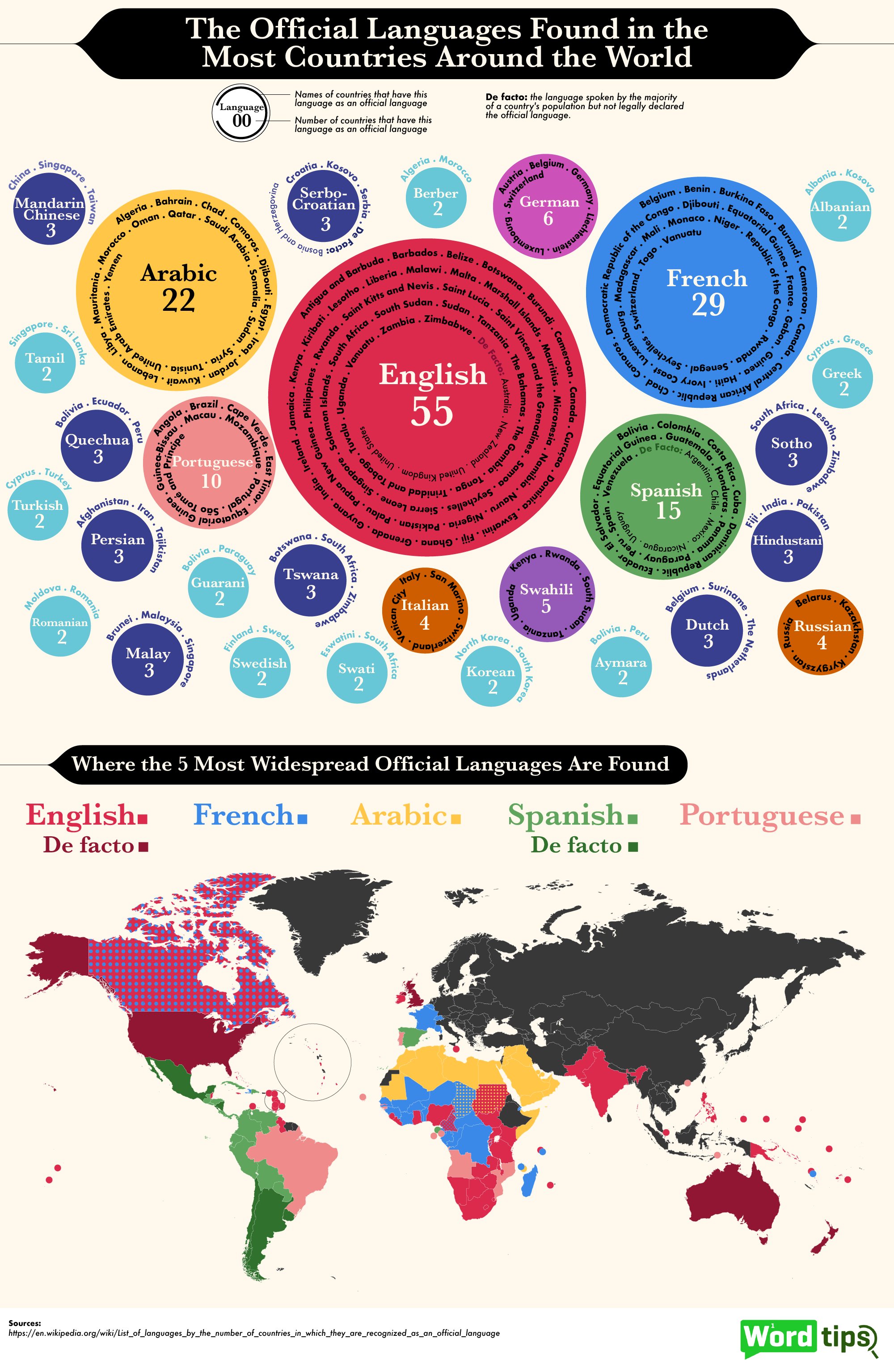
While a majority of the official languages included on this linguistic chart are commonly found in the same region of the world, others are far more widespread and have been deemed the official language in countries across the world. It’s no surprise to find that English is the official language for the most countries by far. There are 55 countries with English as the official language, many of which can be found in Africa, the Caribbean, the Americas, and places in between.
Crossword clues often ask for a country’s official language. If one has you stuck, our crossword solver can help.
What is the official language of the United States? The answer may surprise you. Check out the chart below to see which languages are the official languages of more than one country as well as the countries that have recognized them at a national level. To see which languages people want to learn, check out the language each city wants to learn most, along with the most mispronounced words, the most beautiful words in English and which countries are best at Wordle.
Click to view the full-size infographic
Which Language Is the Official Language of the Most Countries?
English is the official language of 55 countries, the most of any language. But is English the official language of the U.S.? When this chart was made in 2021, it was not: English was the de facto national language, as it is in three other countries. That changed on March 1, 2025, when an executive order designated English as the official language of the United States. A de facto national language is one that is not legally recognized as the de jure (or official) national language but is spoken by a majority of the people in that country.
Through past research, we found that English is also the most commonly spoken language in the world, with more than 1.13 billion speakers.
The Official Languages of More Than One Country
English is the official language of 55 countries: Antigua and Barbuda, Barbados, Belize, Botswana, Burundi, Cameroon, Canada (except Quebec), Curaçao, Dominica, Eswatini, Fiji, Ghana, Grenada, Guyana, India, Ireland, Jamaica, Kenya, Kiribati, Lesotho, Liberia, Malawi, Malta, Marshall Islands, Mauritius, Micronesia, Namibia, Nauru, Nigeria, Pakistan, Palau, Papua New Guinea, Philippines, Rwanda, Saint Kitts and Nevis, Saint Lucia, Saint Vincent and the Grenadines, Samoa, Seychelles, Sierra Leone, Singapore, Solomon Islands, South Africa, South Sudan, Sudan, Tanzania, The Bahamas, The Gambia, Tonga, Trinidad and Tobago, Tuvalu, Uganda, Vanuatu, Zambia, and Zimbabwe. And in 2021, it was the de facto national language in 4 countries: Australia, New Zealand, United Kingdom, and the United States.
French is the official language of 29 countries: Belgium, Benin, Burkina Faso, Burundi, Cameroon, Canada, Central African Republic, Chad, Comoros, Democratic Republic of the Congo, Djibouti, Equatorial Guinea, France, Gabon, Guinea, Haiti, Ivory Coast, Luxembourg, Madagascar, Mali, Monaco, Niger, Republic of the Congo, Rwanda, Senegal, Seychelles, Switzerland, Togo, and Vanuatu.
Since this chart was published, three of these countries have changed the status of French. Mali’s 2023 constitution makes its national languages the official languages and French the working language. Burkina Faso’s constitutional revision of December 2023 makes national languages recognized by law its official languages, with English and French as working languages. Niger’s March 2025 charter names Hausa the national language and English and French the working languages.
Arabic is the official language of 22 countries: Algeria, Bahrain, Chad, Comoros, Djibouti, Egypt, Iraq, Jordan, Kuwait, Lebanon, Libya, Mauritania, Morocco, Oman, Qatar, Saudi Arabia, Somalia, Sudan, Syria, Tunisia, United Arab Emirates, and Yemen.
Spanish is the official language of 15 countries: Bolivia, Colombia, Costa Rica, Cuba, Dominican Republic, Ecuador, El Salvador, Equatorial Guinea, Guatemala, Honduras, Panama, Paraguay, Peru, Spain, and Venezuela. And it’s the de facto national language in 5 countries: Argentina, Chile, Mexico, Nicaragua, and Uruguay.
Portuguese is the official language of 10 countries: Angola, Brazil, Cape Verde, East Timor, Equatorial Guinea, Guinea-Bissau, Macau, Mozambique, Portugal, and São Tomé and Príncipe.
German is the official language of 6 countries: Austria, Belgium, Germany, Liechtenstein, Luxembourg, and Switzerland.
Swahili is the official language of 6 countries: Democratic Republic of the Congo, Kenya, Rwanda, South Sudan, Tanzania, and Uganda.
Russian is the official language of 4 countries: Belarus, Kazakhstan, Kyrgyzstan, and Russia.
Italian is the official language of 4 countries: Italy, San Marino, Switzerland, and Vatican City.
Malay is the official language of 3 countries: Brunei, Malaysia, and Singapore.
Serbo-Croatian is the official language of 3 countries: Croatia, Kosovo, and Serbia. And it’s the de facto national language in 1 country: Bosnia and Herzegovina.
Tswana is the official language of 3 countries: Botswana, South Africa, and Zimbabwe.
Dutch is the official language of 3 countries: Belgium, Suriname, and The Netherlands.
Hindustani is the official language of 3 countries: Fiji, India, and Pakistan.
Persian is the official language of 3 countries: Afghanistan, Iran, and Tajikistan.
Quechua is the official language of 3 countries: Bolivia, Ecuador, and Peru.
Sotho is the official language of 3 countries: South Africa, Lesotho, and Zimbabwe.
Mandarin Chinese is the official language of 3 countries: China, Singapore, and Taiwan.
Albanian is the official language of 2 countries: Albania and Kosovo.
Tamil is the official language of 2 countries: Singapore and Sri Lanka.
Turkish is the official language of 2 countries: Cyprus and Turkey.
Romanian is the official language of 2 countries: Moldova and Romania.
Aymara is the official language of 2 countries: Bolivia and Peru.
Berber is the official language of 2 countries: Algeria and Morocco.
Greek is the official language of 2 countries: Cyprus and Greece.
Guarani is the official language of 2 countries: Bolivia and Paraguay.
Korean is the official language of 2 countries: North Korea and South Korea.
Swati is the official language of 2 countries: Eswatini and South Africa.
Swedish is the official language of 2 countries: Finland and Sweden.