
Today's Bracket City Hints & Answers for Mar 29
Bracket City Sun Mar 29 solution!
Today's Mini Crossword
Love the NYT Mini? You'll like our free daily Mini Crossword. Fresh puzzles every day, no paywall. Like NYT Mini, but free. Forever. No paywall.
Today’s Bracket City Solution
Today’s Bracket City Clues

Daily Games Hints & Answers:
We also help our users decode other daily word-guessing games.
How to Play Bracket City - Complete Guide
Understanding Bracket City Puzzles
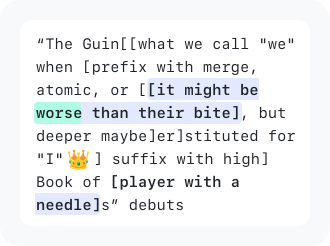
Bracket City is a daily word and trivia game from The Atlantic where you solve nested bracketed clues to reveal a historical fact. Each puzzle presents a sentence with multiple brackets [like this], and each bracket contains a clue you must solve. When you type the correct answer, that bracket expands to show the next layer of clues, creating a chain reaction that gradually unveils the complete historical sentence.
Starting Your Daily Puzzle
Open today's Bracket City puzzle and you'll see the outermost bracketed clue displayed at the top. This is your entry point into the nested puzzle structure. Simply start typing your answer, no clicking required and hit Enter. Each correct answer removes one layer of brackets and reveals new clues hidden within, leading you deeper toward the final historical event.
How Nested Brackets Work
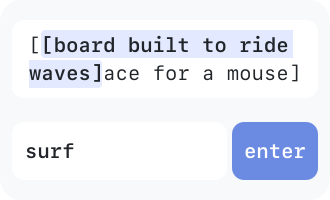
- You start with a bracket containing a clue, like: "[board built to ride waves]".
- Type the answer "surf" and hit enter
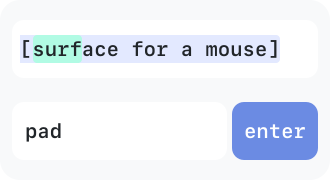
- That bracket expands to reveal MORE text with a NEW bracket inside: "[surface for a mouse]"
- Type "pad" to solve this inner bracket
- The complete phrase is revealed: "surfboard" (or whatever the final word/phrase is)
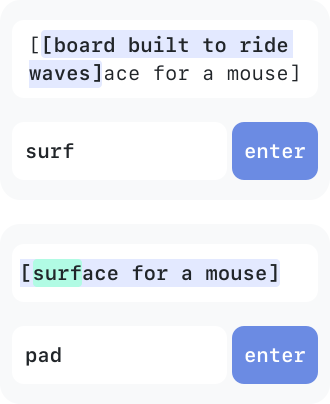
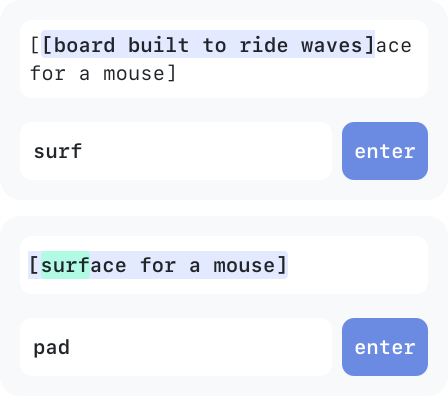
Each bracket you solve removes one layer and reveals what was hidden inside. Multiple brackets can be nested within each other, and the sentence gradually builds as you work through each layer. You're not solving the same clue multiple times. Each bracket is a completely different clue that reveals the next piece of the puzzle.
Think of it like Russian nesting dolls: solving the outer layer reveals a new, smaller puzzle inside, until you reach the final complete historical sentence.
The Historical Connection
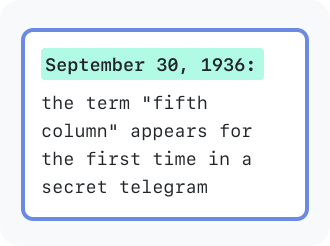
Every Bracket City puzzle ties to an event that happened on today's date in history. This educational element distinguishes it from pure word games. You're not just solving clues, you're discovering real historical moments. The final revealed sentence always teaches you something meaningful about the past, whether it's a scientific breakthrough, political milestone, cultural event, or significant birth or death.
Scoring System and Ranks
Bracket City tracks your solving performance and awards you one of three ranks:
Your final score factors in wrong answers (each mistake adds penalties), peeks at clues (viewing hints without revealing), and revealed answers (showing the solution directly). The game also displays your total keystrokes compared to the minimum possible, showing your efficiency.
Hard Mode and Game Settings
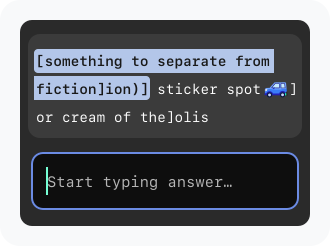
Hard Mode makes every keystroke count by removing the submit button. Your answer submits automatically when you hit the required character count. This increases difficulty by removing the safety net of reviewing before submission.
Dark Mode provides a darker visual theme to reduce eye strain during extended play sessions. Both modes are optional and can be toggled in settings.
Peek vs Reveal Strategy
When stuck, you have two assistance options:
Strategic use of peeks can help you maintain momentum without completely spoiling the puzzle, while reveals should be saved for when you're truly stuck and want to continue the experience.
Tips for Solving Bracket City Faster
Identify Quick Wins First
Scan the visible brackets for short, straightforward clues. Single-word answers or well-known historical facts should be solved immediately to unlock more context. Once you solve a few easy brackets, the emerging sentence structure helps you deduce harder clues.
Leverage the Historical Date
Remember that every puzzle connects to today's specific date in history. If you see a year in the clue, think about major events from that year related to the date you're playing on. This narrows possibilities dramatically. For example, a December 7th puzzle mentioning 1941 almost certainly involves Pearl Harbor.
Use Context from Partial Sentences
As you solve brackets, the sentence becomes clearer. Use grammatical context to predict what type of answer fits. If the sentence reads "In 1776, [person] signed the Declaration," you know you need a proper name. If it says "[number] states ratified," you're looking for a specific count.
Work Backwards from What You Know
If you recognize the historical event from partial information, work backwards to fill in specific details. Know it's about the moon landing but stuck on spacecraft names? Use what you know about Apollo 11 to tackle the specific brackets asking for crew members, dates, or mission details.
Minimize Wrong Guesses
Each incorrect answer damages your score and rank potential. If you're uncertain, take an extra moment to consider alternatives before typing. Two wrong guesses can drop you from Kingmaker to Mayor territory, while a clean solve keeps you in perfect score range.
Strategic Peeking Technique
Don't be afraid to peek at one difficult bracket to maintain flow rather than revealing multiple answers in frustration. A single peek keeps you engaged in the solving process and preserves most of your score, while multiple reveals quickly tank your ranking.
Learn Historical Patterns
After playing regularly, you'll notice certain historical categories appear frequently: space exploration milestones, presidential actions, scientific discoveries, Supreme Court decisions, and cultural firsts. Building familiarity with these common themes improves your solving speed over time.
Bracket City FAQ
What is today's Bracket City?
Bracket City is a daily word and trivia game from The Atlantic. Each puzzle leads you through nested bracketed clues, where every correct answer builds toward a final sentence that highlights an event from this day in history.
Who created Bracket City?
The game was created by Ben Gross and launched on January 1, 2025. In April 2025, it officially became part of The Atlantic's Games platform, alongside other daily puzzles like the Mini Crossword and Connections.
What do the brackets mean in Bracket City?
Brackets [ ] indicate unsolved clues in the puzzle. Each bracket contains a clue you must answer. When you solve it correctly, that bracket disappears and may reveal additional nested brackets within, creating layers of clues that progressively unveil the historical sentence.
How many clues are in each day's puzzle?
The number of bracketed clues varies by day, typically ranging from 5 to 15 brackets depending on the complexity of the historical event. Some days feature straightforward events with fewer layers, while others involve intricate stories requiring more clues.
Do I get a score in Bracket City?
Yes. Every player earns a rank based on solving performance. Your score accounts for wrong guesses, peeks, and reveals. Titles range from "Commuter" (basic completion) to "Mayor" (strong performance) to "Kingmaker" (perfect solve with no errors or assistance).
What types of historical events are featured?
Bracket City covers diverse historical moments: scientific breakthroughs, political milestones, space exploration, cultural achievements, important births and deaths, Supreme Court decisions, military events, and social movements. Each puzzle ties to something significant that happened on the current calendar date.
Can I play Bracket City on mobile?
Absolutely. Bracket City is fully playable on both desktop and mobile devices. Simply type your answers using your phone or tablet keyboard—the interface adapts seamlessly to touchscreens.
When does Bracket City update?
The puzzle refreshes every day at midnight Eastern Time, bringing you a brand-new historical challenge tied to that specific date.
Can I replay previous days' puzzles?
This depends on The Atlantic's platform features. Check the game interface for an archive or past puzzles section. Some daily puzzle platforms maintain archives for subscribers.
How is Bracket City different from crossword puzzles?
Unlike crosswords that spread across a grid with intersecting answers, Bracket City follows a linear path of nested clues. Each solved clue unlocks the next in sequence, making it more like unwrapping a puzzle sentence rather than filling a spatial grid. There are no crossing letters or pattern-based deductions.
Is there a time limit in Bracket City?
No. Bracket City has no timer, allowing you to solve at your own pace. Your score is based on accuracy and assistance used, not speed, so you can think carefully about each answer without time pressure.