
Today's NYT Pips Solver Answers & Hints for Apr 12
NYT Pips Sun Apr 12 solution!
Today's Mini Crossword
Love the NYT Mini? You'll like our free daily Mini Crossword. Fresh puzzles every day, no paywall. Like NYT Mini, but free. Forever. No paywall.
Today's Hints & Answers
Medium difficulty hints, answers for April 12, 2026
Reveal by clicking a domino below OR a cell on the board

Daily Games Hints & Answers:
We also help our users decode other daily word-guessing games.
How to Play NYT Pips - The Complete Game Guide
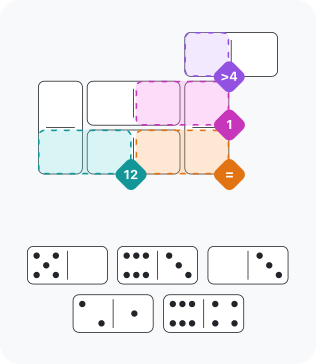
Getting Started with Today's Pips Puzzle
Open today's NYT Pips puzzle and you'll see a grid divided into color-coded regions. Below the board are your domino tiles (showing 0-6 pips each). Click or tap any square to begin placing dominoes—the active region's constraint rule displays automatically so you always know what logic puzzle requirement you're trying to satisfy.
Understanding Pips Rules and Symbols
NYT Pips is a domino logic puzzle where every colored region has a specific mathematical constraint you must satisfy:
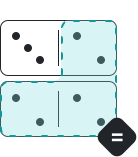
= (Equal symbol):
All domino halves in this region must be the same pip number
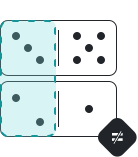
≠ (Not equal):
Each domino half must be a different pip number - no repeats allowed
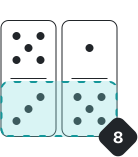
Number target (e.g., 8, 12):
Total pip count in the region must equal that exact sum
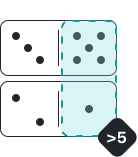
> n (Greater than):
Each square's pip value must be higher than the shown number
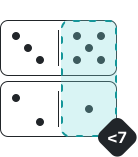
< n (Less than):
Each square's pip value must be lower than the shown number
'%3e%3c/path%3e%3cpath%20d='M109,80%20C113.418278,80%20117,83.581722%20117,88%20L117,128%20C117,132.418278%20113.418278,136%20109,136%20L8,136%20C3.581722,136%200,132.418278%200,128%20L0,88%20C0,83.581722%203.581722,80%208,80%20L109,80%20Z%20M109,81%20L8,81%20C4.13400675,81%201,84.1340068%201,88%20L1,128%20C1,131.865993%204.13400675,135%208,135%20L109,135%20C112.865993,135%20116,131.865993%20116,128%20L116,88%20C116,84.1340068%20112.865993,81%20109,81%20Z%20M59,90%20L59,126%20L58,126%20L58,90%20L59,90%20Z%20M40,117%20C42.209139,117%2044,118.790861%2044,121%20C44,123.209139%2042.209139,125%2040,125%20C37.790861,125%2036,123.209139%2036,121%20C36,118.790861%2037.790861,117%2040,117%20Z%20M89,104%20C91.209139,104%2093,105.790861%2093,108%20C93,110.209139%2091.209139,112%2089,112%20C86.790861,112%2085,110.209139%2085,108%20C85,105.790861%2086.790861,104%2089,104%20Z%20M16,93%20C18.209139,93%2020,94.790861%2020,97%20C20,99.209139%2018.209139,101%2016,101%20C13.790861,101%2012,99.209139%2012,97%20C12,94.790861%2013.790861,93%2016,93%20Z%20M109,19%20C113.418278,19%20117,22.581722%20117,27%20L117,67%20C117,71.418278%20113.418278,75%20109,75%20L8,75%20C3.581722,75%200,71.418278%200,67%20L0,27%20C0,22.581722%203.581722,19%208,19%20L109,19%20Z%20M109,20%20L8,20%20C4.13400675,20%201,23.1340068%201,27%20L1,67%20C1,70.8659932%204.13400675,74%208,74%20L109,74%20C112.865993,74%20116,70.8659932%20116,67%20L116,27%20C116,23.1340068%20112.865993,20%20109,20%20Z%20M59,29%20L59,65%20L58,65%20L58,29%20L59,29%20Z%20M77,55%20C79.209139,55%2081,56.790861%2081,59%20C81,61.209139%2079.209139,63%2077,63%20C74.790861,63%2073,61.209139%2073,59%20C73,56.790861%2074.790861,55%2077,55%20Z%20M101,55%20C103.209139,55%20105,56.790861%20105,59%20C105,61.209139%20103.209139,63%20101,63%20C98.790861,63%2097,61.209139%2097,59%20C97,56.790861%2098.790861,55%20101,55%20Z%20M40,55%20C42.209139,55%2044,56.790861%2044,59%20C44,61.209139%2042.209139,63%2040,63%20C37.790861,63%2036,61.209139%2036,59%20C36,56.790861%2037.790861,55%2040,55%20Z%20M89,43%20C91.209139,43%2093,44.790861%2093,47%20C93,49.209139%2091.209139,51%2089,51%20C86.790861,51%2085,49.209139%2085,47%20C85,44.790861%2086.790861,43%2089,43%20Z%20M28,43%20C30.209139,43%2032,44.790861%2032,47%20C32,49.209139%2030.209139,51%2028,51%20C25.790861,51%2024,49.209139%2024,47%20C24,44.790861%2025.790861,43%2028,43%20Z%20M77,31%20C79.209139,31%2081,32.790861%2081,35%20C81,37.209139%2079.209139,39%2077,39%20C74.790861,39%2073,37.209139%2073,35%20C73,32.790861%2074.790861,31%2077,31%20Z%20M101,31%20C103.209139,31%20105,32.790861%20105,35%20C105,37.209139%20103.209139,39%20101,39%20C98.790861,39%2097,37.209139%2097,35%20C97,32.790861%2098.790861,31%20101,31%20Z%20M16,31%20C18.209139,31%2020,32.790861%2020,35%20C20,37.209139%2018.209139,39%2016,39%20C13.790861,39%2012,37.209139%2012,35%20C12,32.790861%2013.790861,31%2016,31%20Z'%20id='Shape'%20fill='%23212529'%20fill-rule='nonzero'%20mask='url(%23mask-2)'%3e%3c/path%3e%3c/g%3e%3c/g%3e%3c/svg%3e)
Blank/uncolored regions:
No mathematical constraints—any pip value allowed
Domino Placement Strategies and Mechanics
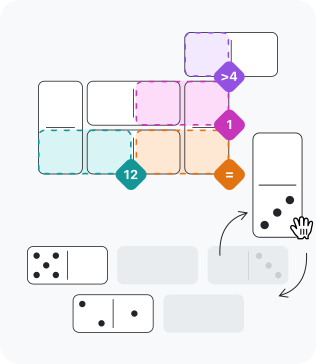
Rotating and positioning dominoes: Drag tiles onto the Pips grid, then rotate horizontally or vertically as needed. Unlike traditional domino games, adjacent tiles don't need matching ends—only the region constraint rules matter for solving.
Cross-region tile placement: A single domino can span two different colored regions, letting each half satisfy separate mathematical rules simultaneously. This cross-region strategy is key for solving harder Pips puzzles efficiently.
Strategic tile routing: Use blank spaces with no constraints to route difficult domino placements when tight mathematical requirements limit your options in other regions.
Logic-Based Solving Techniques and Advanced Strategies
Start with forced puzzle moves: Begin with single-square regions
 , exact sum targets
 , and tight greater-than/less
-than constraints
, and tight greater-than/less
-than constraints
 that severely limit possible
pip values.
that severely limit possible
pip values.
Build from anchor points: Once you place dominoes in highly constrained areas, extend your solution outward to adjacent regions, using the locked-in values to deduce neighboring placements.
Map duplicate requirements: In equal (=) regions
 , count how many copies
of each pip number you'll need across the entire puzzle. In not-equal (≠) regions
, count how many copies
of each pip number you'll need across the entire puzzle. In not-equal (≠) regions
 eliminate repeat
numbers.
eliminate repeat
numbers.
Leverage board edges and corners: Border squares restrict domino orientation — use corners and edges to lock tiles into specific positions, reducing possible placements for logical deduction.
Mathematical pre-planning: Before dragging dominoes around,
check if sum targets are even  or odd
  and determine which two pip numbers
can mathematically achieve the target total.
and determine which two pip numbers
can mathematically achieve the target total.
Mathematical verification: After each domino placement, recount pip totals in sum-target regions and verify equal/not-equal constraints are still satisfiable.
Strategic experimentation: No timer pressure means you can place dominoes, evaluate downstream consequences, then undo quickly if a later region becomes impossible to satisfy.
NYT Pips Difficulty Levels Explained
- ✌️
Easy Pips puzzles: Fewer total dominoes required, simpler mathematical constraints, more blank spaces for flexible routing.
- 👍
Medium Pips puzzles: Moderate complexity mixing different constraint types, requiring some logical deduction and mathematical planning.
- 💪
Hard Pips puzzles: Maximum dominoes needed, tighter mathematical logic requirements, complex interweaving of multiple constraint types demanding careful systematic solving.
Winning Conditions and Puzzle Completion 🏆
You successfully solve today's NYT Pips puzzle when every grid square is filled with domino halves, all colored regions satisfy their mathematical rules, and you've placed all available domino tiles. Some daily puzzles include bonus cookie rewards for fast completion times, though accuracy and logical thinking matter most for puzzle mastery.
NYT Pips FAQ
What is today's Pips?
Pips is a daily New York Times logic puzzle inspired by dominoes. You place tiles showing two pip counts onto a grid so that every color-coded region satisfies its numeric rule. No word knowledge needed,just deduction and spatial reasoning.
How do the symbols in Pips work?
= means all halves in the region are the same number; ≠ means they're all different. A number by itself is a sum target for that region. > and < compare each covered square's value to the shown number. Blank regions have no extra rule.
Do touching domino tiles have to match?
No. Unlike classic domino play, adjacent tiles in Pips don’t need matching ends. You only need to satisfy the region constraints where each half lands.
Can one domino cover two different regions?
Yes. A single tile can span two regions, letting each half satisfy a different rule, a key tactic on tougher boards.
Is there a timer or penalty for mistakes?
There's no timer and you can undo freely. Experiment, backtrack, and refine placements without pressure.
When does today's Pips refresh?
Daily. A fresh set of Easy, Medium, and Hard puzzles appears every day so you can add Pips to your solving routine.